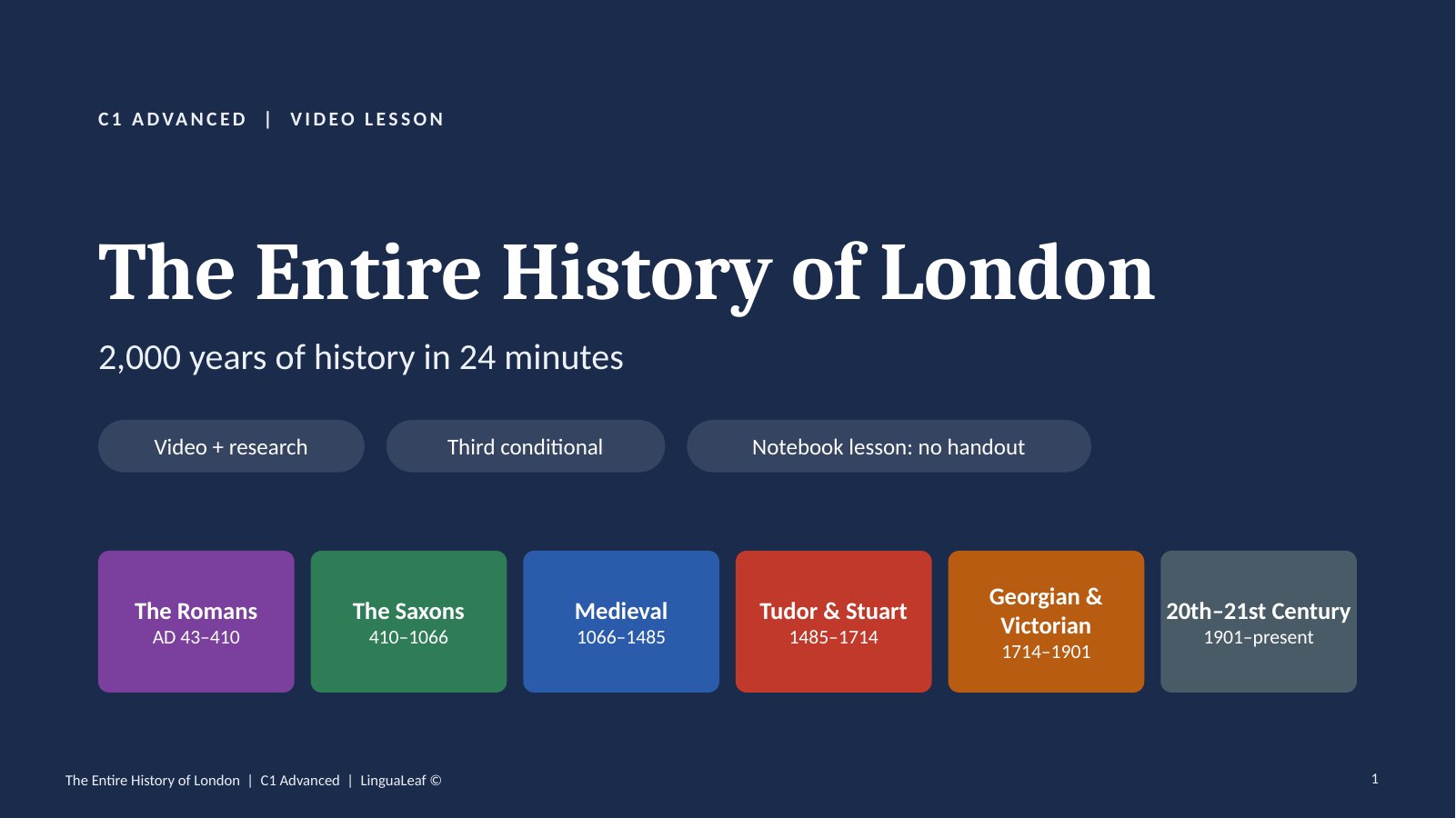
About this lesson
Students watch a 24-minute video covering 2,000 years of London’s history, from Roman Londinium to the modern metropolis. The facts come first and the grammar second: once the class shares a set of real events, they use the third conditional to imagine how history could have gone differently. If the Normans hadn’t invaded in 1066, English might have developed very differently.
At a glance
- Level: C1 Advanced, teens or adults
- Length: 90 minutes, plus research homework and 20 minutes of presentations next lesson. Flipped and 180-minute versions are in the teacher’s notes.
- Grammar: third conditional review, including might have and could have, passive forms and natural contractions
- Vocabulary: 10 history terms (Londinium, the Magna Carta, the Blitz, urban sprawl…) and 8 academic words (pivotal, decimated, infrastructure…)
- Skills: extended listening for sequence and detail, True / False / Not Given, online research, a short structured presentation
- You’ll need: the video with sound, and one internet device per student or pair for the research stage
Lesson stages
- Warm-up: a timeline of six eras and four discussion questions
- Key vocabulary: matching and gap-fill before watching
- While watching: put ten events in order, then True / False / Not Given
- Grammar focus: third conditional review, controlled then freer practice
- Speaking: “What if history had been different?”, then students’ own countries
- Research and presentation: the East India Company plus one event of the student’s choice, presented in groups of three